
Flight Time Limitations, explained
Flight Time Limitations (FTL) are the rules that cap how long air crew may fly, be on duty and stay awake — and how much rest they must get in between. This is a working reference to the EASA limits, the full set of official definitions, and the source documents they come from.
- Basic max FDP
- 13:00 1–2 sectors, acclimatised
- Flight time
- 1000 h per 12 consecutive months
- Duty
- 190 h per 28 days
- WOCL
- 02:00–05:59 window of circadian low
What are Flight Time Limitations?
Flight Time Limitations (FTL) are the regulatory limits on flight time, flight duty period and duty period, together with the minimum rest that must be given to air crew. Their purpose is to keep crew fatigue from eroding flight safety. In Europe they are set out in Regulation (EU) No 965/2012, Annex III, Part-ORO, Subpart FTL — the rules usually cited as ORO.FTL.
Because most aviation incidents and accidents involve human factors, fatigue is treated as a major contributor to human error. It has been a civil aviation concern since the 1944 Chicago Convention, and today every commercial air transport operator must publish an FTL scheme and monitor compliance against it.
Headline limits
Maximum daily FDP
13:00For an acclimatised crew member starting between 06:00 and 13:29 flying 1–2 sectors. It reduces by 30 minutes for each additional sector, down to a floor of 9:00, and reduces further for duties starting early or encroaching on the night.
ORO.FTL.205(b)Cumulative duty
190 hTotal duty in any 28 consecutive days, spread as evenly as practicable. Shorter windows also apply: 60 hours in 7 consecutive days and 110 hours in 14 consecutive days.
ORO.FTL.210(a)Cumulative flight time
1000 hTotal block time in any 12 consecutive months, alongside 900 hours per calendar year and 100 hours in any 28 consecutive days.
ORO.FTL.210(b)Minimum rest at home base
12 hOr the length of the preceding duty period, whichever is greater. Away from home base the minimum is 10 hours, which must allow an 8-hour sleep opportunity plus travel and physiological needs.
ORO.FTL.235(a)–(b)Extended recovery rest
36 hA recurrent extended recovery rest period including two local nights, such that no more than 168 hours pass between the end of one and the start of the next. It is extended to two local days twice every month.
ORO.FTL.235(d)Window of circadian low
02:00–05:59The period of lowest alertness in the time zone a crew member is acclimatised to. Duties encroaching on the WOCL attract reduced maximum FDPs.
ORO.FTL.105Maximum daily FDP — acclimatised crew
This is ORO.FTL.205(b) Table 2: the basic maximum daily flight duty period, before any extension, for a crew member who is acclimatised. Read down to the band your duty starts in, across to the number of sectors.
| Start of FDP | 1–2 | 3 | 4 | 5 | 6 | 7 | 8 | 9 | 10 |
|---|---|---|---|---|---|---|---|---|---|
| 0600–1329 | 13:00 | 12:30 | 12:00 | 11:30 | 11:00 | 10:30 | 10:00 | 09:30 | 09:00 |
| 1330–1359 | 12:45 | 12:15 | 11:45 | 11:15 | 10:45 | 10:15 | 09:45 | 09:15 | 09:00 |
| 1400–1429 | 12:30 | 12:00 | 11:30 | 11:00 | 10:30 | 10:00 | 09:30 | 09:00 | 09:00 |
| 1430–1459 | 12:15 | 11:45 | 11:15 | 10:45 | 10:15 | 09:45 | 09:15 | 09:00 | 09:00 |
| 1500–1529 | 12:00 | 11:30 | 11:00 | 10:30 | 10:00 | 09:30 | 09:00 | 09:00 | 09:00 |
| 1530–1559 | 11:45 | 11:15 | 10:45 | 10:15 | 09:45 | 09:15 | 09:00 | 09:00 | 09:00 |
| 1600–1629 | 11:30 | 11:00 | 10:30 | 10:00 | 09:30 | 09:00 | 09:00 | 09:00 | 09:00 |
| 1630–1659 | 11:15 | 10:45 | 10:15 | 09:45 | 09:15 | 09:00 | 09:00 | 09:00 | 09:00 |
| 1700–0459 | 11:00 | 10:30 | 10:00 | 09:30 | 09:00 | 09:00 | 09:00 | 09:00 | 09:00 |
| 0500–0514 | 12:00 | 11:30 | 11:00 | 10:30 | 10:00 | 09:30 | 09:00 | 09:00 | 09:00 |
| 0515–0529 | 12:15 | 11:45 | 11:15 | 10:45 | 10:15 | 09:45 | 09:15 | 09:00 | 09:00 |
| 0530–0544 | 12:30 | 12:00 | 11:30 | 11:00 | 10:30 | 10:00 | 09:30 | 09:00 | 09:00 |
| 0545–0559 | 12:45 | 12:15 | 11:45 | 11:15 | 10:45 | 10:15 | 09:45 | 09:15 | 09:00 |
When the acclimatisation state is unknown
If the crew member is in an unknown state of acclimatisation — “X” in Table 1 below — the maximum daily FDP is shorter. An operator running a Fatigue Risk Management system that continuously monitors safety performance may use the more generous Table 4 values instead.
| Sectors | 1–2 | 3 | 4 | 5 | 6 | 7 | 8 |
|---|---|---|---|---|---|---|---|
| Table 3 — without FRM | 11:00 | 10:30 | 10:00 | 09:30 | 09:00 | 09:00 | 09:00 |
| Table 4 — with FRM | 12:00 | 11:30 | 11:00 | 10:30 | 10:00 | 09:30 | 09:00 |
Working out the acclimatisation state
Table 1 of ORO.FTL.105 decides which state a crew member is in: B — acclimatised to the local time of the departure time zone; D — acclimatised to the local time where the next duty starts; X — unknown.
| Time difference | < 48 h | 48–71:59 | 72–95:59 | 96–119:59 | ≥ 120 h |
|---|---|---|---|---|---|
| < 4 h | B | D | D | D | D |
| ≤ 6 h | B | X | D | D | D |
| ≤ 9 h | B | X | X | D | D |
| ≤ 12 h | B | X | X | X | D |
Extensions
Two mechanisms push the maximum back up. An extension without in-flight rest adds up to 1 hour, no more than twice in any 7 consecutive days. It must be planned in advance, the pre- and post-flight rest must grow (by 2 hours each, or 4 hours added to the post-flight rest), and it is capped at 5 sectors when the WOCL is not encroached, 4 sectors when the WOCL is encroached by 2 hours or less, and 2 sectors when it is encroached by more than 2 hours. It cannot be combined with in-flight rest or split duty extensions in the same duty period.
Augmented crew with in-flight rest allows substantially longer FDPs under ORO.FTL.205(e). The exact values live in the operator's flight time specification scheme, set against the applicable certification specifications, taking account of sectors flown, minimum in-flight rest per crew member, the class of rest facility and the degree of crew augmentation.
Standby, split duty, positioning and reserve each have their own treatment, and an operator's approved FTL scheme may be more restrictive than the regulation. Where cabin crew need a longer pre-flight briefing than the flight crew, their FDP may be extended by that difference, up to 1 hour.
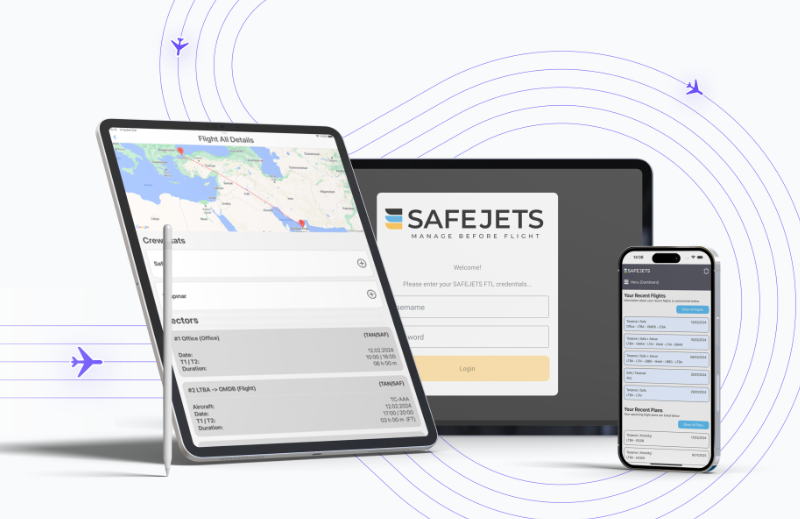
Calculating these limits by hand does not scale. SAFEJETS FTL monitors flight duty, rest and cumulative limits across your whole roster and flags breaches before the flight, not after.
FTL definitions
The complete set of definitions used throughout Subpart FTL. These are the terms that decide how every limit is calculated, so precision matters — “duty”, “duty period” and “flight duty period” are three different things.
- acclimatised
- A state in which a crew member’s circadian biological clock is synchronised to the time zone where the crew member is. A crew member is considered to be acclimatised to a 2-hour wide time zone surrounding the local time at the point of departure. When the local time at the place where a duty commences differs by more than 2 hours from the local time at the place where the next duty starts, the crew member, for the calculation of the maximum daily flight duty period, is considered to be acclimatised in accordance with the values in Table 1 of ORO.FTL.105 (reproduced under acclimatisation above).
- reference time
- The local time at the reporting point situated in a 2-hour wide time zone band around the local time where a crew member is acclimatised.
- accommodation
- For the purpose of standby and split duty, a quiet and comfortable place not open to the public with the ability to control light and temperature, equipped with adequate furniture that provides a crew member with the possibility to sleep, with enough capacity to accommodate all crew members present at the same time and with access to food and drink.
- suitable accommodation
- For the purpose of standby, split duty and rest, a separate room for each crew member located in a quiet environment and equipped with a bed, which is sufficiently ventilated, has a device for regulating temperature and light intensity, and access to food and drink.
- augmented flight crew
- A flight crew which comprises more than the minimum number required to operate the aircraft, allowing each flight crew member to leave the assigned post, for the purpose of in-flight rest, and to be replaced by another appropriately qualified flight crew member.
- break
- A period of time within a flight duty period, shorter than a rest period, counting as duty and during which a crew member is free of all tasks.
- delayed reporting
- The postponement of a scheduled FDP by the operator before a crew member has left the place of rest.
- disruptive schedule
- A crew member’s roster which disrupts the sleep opportunity during the optimal sleep time window by comprising an FDP or a combination of FDPs which encroach, start or finish during any portion of the day or of the night where a crew member is acclimatised. A schedule may be disruptive due to early starts, late finishes or night duties.
- early type (of disruptive schedule)
- An “early start” is a duty period starting in the period between 05:00 and 05:59 in the time zone to which a crew member is acclimatised; a “late finish” is a duty period finishing in the period between 23:00 and 01:59 in the time zone to which a crew member is acclimatised.
- late type (of disruptive schedule)
- An “early start” is a duty period starting in the period between 05:00 and 06:59 in the time zone to which a crew member is acclimatised; a “late finish” is a duty period finishing in the period between 00:00 and 01:59 in the time zone to which a crew member is acclimatised.
- night duty
- A duty period encroaching any portion of the period between 02:00 and 04:59 in the time zone to which the crew is acclimatised.
- duty
- Any task that a crew member performs for the operator, including flight duty, administrative work, giving or receiving training and checking, positioning, and some elements of standby.
- duty period
- A period which starts when a crew member is required by an operator to report for or to commence a duty and ends when that person is free of all duties, including post-flight duty.
- flight duty period (FDP)
- A period that commences when a crew member is required to report for duty, which includes a sector or a series of sectors, and finishes when the aircraft finally comes to rest and the engines are shut down, at the end of the last sector on which the crew member acts as an operating crew member.
- flight time
- For aeroplanes, the time between an aircraft first moving from its parking place for the purpose of taking off until it comes to rest on the designated parking position and all engines or propellers are shut down.
- home base
- The location, assigned by the operator to the crew member, from where the crew member normally starts and ends a duty period or a series of duty periods and where, under normal circumstances, the operator is not responsible for the accommodation of the crew member concerned.
- local day
- A 24-hour period commencing at 00:00 local time.
- local night
- A period of 8 hours falling between 22:00 and 08:00 local time.
- operating crew member
- A crew member carrying out duties in an aircraft during a sector.
- positioning
- The transferring of a non-operating crew member from one place to another, at the behest of the operator, excluding the time of travel from a private place of rest to the designated reporting place at home base and vice versa, and the time for local transfer from a place of rest to the commencement of duty and vice versa.
- rest facility
- A bunk or seat with leg and foot support suitable for crew members’ sleeping on board an aircraft.
- reserve
- A period of time during which a crew member is required by the operator to be available to receive an assignment for an FDP, positioning or other duty notified at least 10 hours in advance.
- rest period
- A continuous, uninterrupted and defined period of time, following duty or prior to duty, during which a crew member is free of all duties, standby and reserve.
- rotation
- A duty or a series of duties, including at least one flight duty, and rest periods out of home base, starting at home base and ending when returning to home base for a rest period where the operator is no longer responsible for the accommodation of the crew member.
- single day free of duty
- For the purpose of complying with the provisions of Council Directive 2000/79/EC, a time free of all duties and standby consisting of one day and two local nights, which is notified in advance. A rest period may be included as part of the single day free of duty.
- sector
- The segment of an FDP between an aircraft first moving for the purpose of taking off until it comes to rest after landing on the designated parking position.
- standby
- A pre-notified and defined period of time during which a crew member is required by the operator to be available to receive an assignment for a flight, positioning or other duty without an intervening rest period.
- airport standby
- A standby performed at the airport.
- other standby
- A standby either at home or in a suitable accommodation.
- window of circadian low (WOCL)
- The period between 02:00 and 05:59 hours in the time zone to which a crew member is acclimatised.
No definition matches that filter.
Flight operations management, built around these rules
SAFEJETS FTL turns the regulation on this page into a live picture of your operation: every duty, every rest period and every cumulative limit tracked against the scheme your authority approved.
- Flight and duty time monitoring against maximum FDP and rest requirements
- Cumulative 7 / 14 / 28-day and 12-month limits watched continuously
- Automatic reports for the authority and for internal compliance monitoring
- Aerodrome competence, off-day arrangement and documents on board
- Optional training (PTM), cost (CM) and carbon emission (CEM) modules
Used by operators to keep rosters legal before they are published.
Fatigue Risk Management (FRMS)
Prescriptive FTL limits are a blunt instrument: they constrain the roster but they do not measure whether crew are actually rested.
A Fatigue Risk Management System (FRMS) is the data-driven counterpart. It uses scientific principles, operational experience and measurement to manage fatigue risk continuously, and it can support variations from the prescriptive limits where an operator can demonstrate an equivalent or better level of safety. Under EASA rules, operators must manage fatigue risk within their management system regardless of whether they hold an FRMS approval.
In practice that means collecting duty and rest data, reported fatigue, and roster stability metrics — then acting on them. The guidance material below, from ICAO, EASA, Eurocontrol and the UK and Australian authorities, is the standard starting point.
FTL and FRMS resources
Regulations and guidance material published by state authorities and international organisations. We do not guarantee these documents are the current revision — check the authority’s own page before implementing anything from them.
| Publisher | Document | Link |
|---|---|---|
| EUR-Lex | Regulation (EU) No 965/2012 — consolidated text, applicable from 1 May 2025 (authoritative) | Read → |
| EUR-Lex | Regulation (EU) 2024/1111 — latest amendment touching Subpart FTL | Read → |
| EASA | Part-ORO — Organisation Requirements for Air Operations | Visit → |
| FAA | Flightcrew Member Duty and Rest Requirements | PDF → |
| CAA (UK) | EASA FTL Regulations — combined document | PDF → |
| CAA (UK) | EASA FTL — questions & answers | PDF → |
| CAA (UK) | EASA FTL — guidance on acclimatisation | PDF → |
| Publisher | Document | Link |
|---|---|---|
| ICAO | Fatigue Management Guide for Airline Operators | PDF → |
| ICAO | Fatigue Management — programme web page | Visit → |
| ICAO | Doc 9966 — FRMS Manual for Regulators | PDF → |
| EASA | Fatigue Risk Management workshop presentations | ZIP → |
| Eurocontrol | Some Perspectives of Fatigue Risk Management Systems | PDF → |
| CAA (UK) | CAP 371 — Avoidance of Fatigue in Aircrews | PDF → |
| CASA (AU) | Fatigue Risk Management System Handbook | PDF → |
FTL questions, answered
What does FTL stand for in aviation?
FTL stands for Flight Time Limitations — the set of rules limiting flight time, flight duty period and duty period for air crew, together with the minimum rest that must be provided. In Europe they are laid down in Regulation (EU) No 965/2012, Annex III, Part-ORO, Subpart FTL.
What is the difference between duty period and flight duty period?
A duty period starts when the operator requires a crew member to report for any duty and ends when they are free of all duties — it covers administrative work, training, positioning and some standby. A flight duty period (FDP) is narrower: it begins at report for a duty that includes at least one sector and ends when the aircraft comes to rest and the engines are shut down after the last sector.
What is the maximum flight duty period under EASA FTL?
For an acclimatised crew member starting between 06:00 and 13:29 and flying one or two sectors, the basic maximum FDP is 13 hours. It reduces by 30 minutes for each additional sector down to a minimum of 9 hours, and reduces further for duties starting early or encroaching on the window of circadian low. Extensions and augmented crew with in-flight rest can increase it under ORO.FTL.205(d) and (e).
How much rest must crew get between duties?
At home base the minimum rest is 12 hours, or the length of the preceding duty period if that is longer. Away from home base it is 10 hours, or the preceding duty period if longer, and that 10 hours must allow an 8-hour sleep opportunity in addition to travelling time and physiological needs.
What is the window of circadian low (WOCL)?
The WOCL is the period between 02:00 and 05:59 in the time zone a crew member is acclimatised to. It is when human alertness is naturally at its lowest, so duties that encroach on it carry reduced maximum flight duty periods.
What does it mean to be “acclimatised”?
A crew member is acclimatised when their circadian body clock is synchronised to the time zone they are in. They are considered acclimatised to a 2-hour wide time zone band around the local time at the point of departure. Once a duty starts more than 2 hours away from that band, acclimatisation state is determined by the tables in the regulation, and the maximum FDP changes accordingly.
How is FRMS different from FTL?
FTL is prescriptive — fixed limits that apply to everyone. An FRMS is performance-based: it uses data, scientific principles and continuous monitoring to manage fatigue risk, and can support approved variations from the prescriptive limits where an equivalent or better level of safety is demonstrated. Most operators run both.
Do these limits apply to all operators?
Since the scope was rewritten by Regulation (EU) 2024/1111, applicable from 1 May 2025, ORO.FTL.100 states that Subpart FTL sets the flight and duty time limitations and rest requirements for aircrew assigned to commercial air transport (CAT) operations with aeroplanes. Other operation types are addressed separately. Outside Europe, the FAA, CASA and others maintain their own equivalent rule sets, linked in the resources above. In every case your operator's approved flight time specification scheme may be more restrictive than the regulation, and it is the scheme that binds you.
Contact
Spotted an error, know of a resource we should add, or want to talk about FTL software for your operation? Send us a message.
Want to see it on your own roster?
Ask for a walkthrough of SAFEJETS FTL against a duty pattern you actually fly.